Your apartment blackout plan needs a way to stay safe without elevator access, plus assistance if staying becomes dangerous. If you can’t use stairs, arrange accessible backup accommodation, reliable check-ins, and medical-device power before an outage.
A flashlight helps, but it can’t solve a seventh-floor access problem. Start with your building’s procedures, then build a personal plan around your mobility and daily needs.
Key Takeaways
- Arrange a support network with a backup contact, agreed check-in times, and instructions for missed calls.
- Learn your building’s accessible emergency procedures; a running generator doesn’t guarantee elevator service or power inside your apartment.
- Keep essential supplies reachable, and arrange accessible transportation before a scheduled shutoff.
- Call 911 for immediate danger, and explain your exact location and assistance needs.
Build Your Apartment Blackout Plan Around People
Give your support network clear jobs
Choose people who can help: a nearby neighbor, someone outside the building, and a backup contact. Agree on who calls first, who contacts management, and what happens if you don’t answer.
Your helpers need your address, floor, apartment number, and preferred communication method. Also explain any assistance you want with mobility equipment, medication, or service-animal supplies.
Ready.gov’s disability preparedness guidance recommends a support network for emergencies. Make yours useful by discussing tasks before anyone is standing in a dark hallway.
A neighbor can bring water or relay information. Improvising a stair carry with an untrained helper creates serious fall and injury risks.
Keep the plan usable without Wi-Fi
Write your contacts on paper, including management’s after-hours number, your utility’s outage line, and your support network. Store a copy beside your phone charger and another in your go bag.
Agree on a check-in schedule and a response to missed contact. For example, your backup person can contact management if your primary helper can’t reach you.
If you use communication aids, keep a low-tech backup within reach. A written card can explain how you communicate and what assistance you need.
Practice with your helpers. Ready.gov’s disability toolkit supports planning around your needs rather than assuming that everyone can use the same escape route.
Know What Your Building Can Keep Running
Separate elevator backup from elevator availability
An elevator’s battery may support emergency communication or a controlled landing without providing normal passenger service. Don’t count on a ride downstairs because the lobby lights remain on.
Your written building plan needs to identify elevator arrangements, emergency lighting, accessible entrances, garage access, and resident alerts. It should also explain how residents receive updates when internet service fails.
Our guide to building generator limits explains why shared backup power may leave apartment outlets unpowered. Medical equipment needs its own arrangement.
After an elevator stops during an outage, wait for building staff or the elevator company to clear it for use. The return of your kitchen light isn’t an elevator inspection.
Learn the actual accessible emergency route
Some buildings have designated refuge areas, horizontal exits, or qualifying elevators with standby power. Others have different arrangements.
The U.S. Access Board’s egress guidance describes these features, but it doesn’t establish what exists in your building.
Get a building-specific assistance plan from management, with fire or emergency-management professionals involved where needed. Include your floor, communication needs, and how responders receive your location.
An ordinary landing isn’t automatically a designated refuge area. Also, a refuge area doesn’t mean someone knows you’re there.
Your assistance plan must explain both where you’ll wait and how your location reaches the people responsible for helping you.
Store a Small Kit You Can Reach
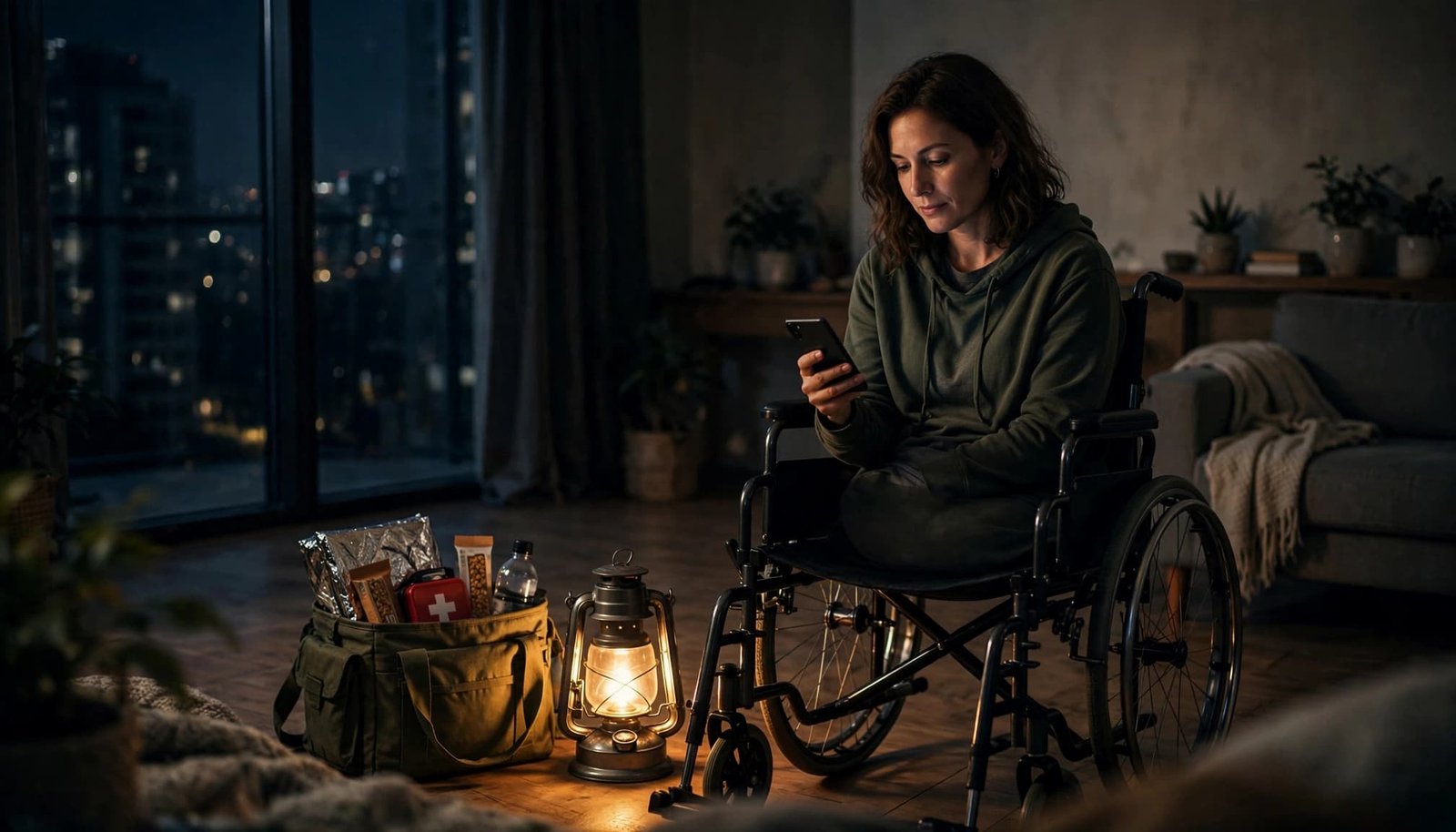
Keep a flashlight, LED lantern, charged power bank, and correct charging cable together. Add paper contacts, first-aid supplies, necessary medicines, and a battery-powered radio.
Store water, ready-to-eat food, and a manual can opener where you can reach them without climbing or moving heavy boxes. Several manageable containers are easier to handle than one heroic emergency trunk.
Your reachable storage matters more than matching bins. Small-space organization works when you can retrieve supplies while seated, tired, or in poor light.
A compact go bag belongs inside your apartment near the exit. Entryway storage must leave door clearance and your mobility route unobstructed. Shared corridors and stairwells aren’t overflow cupboards.
Our apartment outage safety steps cover broader supplies and indoor backup-power precautions.
Use battery lighting instead of candles. Never operate a fuel-burning generator inside your apartment, in a shared hallway, or on a balcony. Carbon monoxide can enter living spaces through open windows.
Keep heavier batteries on a stable, reachable surface with ventilation, rather than balanced on furniture.
Give Medical Power and Mobility Equipment Separate Plans
Match backup power to the equipment
If you use an oxygen concentrator, CPAP machine, or another powered medical device, arrange device-specific backup with your clinician or equipment supplier.
A phone power bank isn’t automatically suitable. Compatibility, output, and operating time all matter. A battery’s watt-hours describe stored energy; its output rating limits what it can run.
The American Red Cross’s outage guidance recommends planning when and how to relocate to maintain medical needs.
For overnight equipment, our CPAP backup-power guidance covers therapy-related planning. Don’t assume building backup or a utility priority list guarantees uninterrupted power.
Include charging, medication, and transfers
Keep powered mobility equipment charged when severe weather or a scheduled shutoff approaches. Store the correct charger somewhere a helper can find it.
Explain how helpers can assist with your equipment and transfers safely. Don’t introduce an unfamiliar transfer technique during an emergency. A manual chair is useful only if it suits your needs and you can use it safely.
Refrigerated medication needs a separate cooling plan. A pharmacist can provide product-specific temperature limits and storage instructions.
Finally, decide what loss of power means for you. Your relocation point may arrive before the apartment feels uncomfortable.
Decide When Staying Home Is Safe
Shelter while conditions remain manageable
A blackout alone doesn’t automatically require evacuation. Staying home may be reasonable when there’s no immediate danger and your essential needs remain covered.
Keep monitoring indoor temperature, available water, medical-device battery levels, and building announcements. During sunny hours, close existing window coverings to limit direct sun in bedrooms. Use installed blackout blinds or blackout shades. Blackout curtains are an option only with an existing, lease-safe setup. Cellular shades, blackout cellular shades, and roller shades can also reduce light. Fabric and fit affect how much light blocking they provide.

Check whether blackout blinds and blackout shades can be operated without power, and monitor whether bedrooms are still becoming too hot. Window treatments and battery fans can’t make an overheating apartment safe.
If management reports impaired fire protection, follow the building’s instructions. Depending on the problem, extra precautions or relocation may be necessary.
Arrange an accessible destination before you need it
Choose somewhere that meets your access, bathroom, charging, and medical needs. Include your mobility device, service animal, or pets in transportation arrangements.
For a scheduled outage, move before elevators stop if you won’t be able to remain safely. Our planned apartment shutoff guide covers preparations while access and charging still work.
Don’t build your plan around neighbors carrying you downstairs. If evacuation equipment forms part of the building’s procedure, trained assistance must be part of that arrangement.
An uncertain restoration estimate shouldn’t become your medical deadline. Leave while the arranged accessible transport is available, rather than waiting until your options shrink.
Follow a Clear Sequence When Power Fails
Keep the first few minutes simple. Your outage response shouldn’t require a midnight treasure hunt.
- Turn on battery lighting and assess immediate hazards, including smoke, burning smells, electrical damage, or medical distress.
- Start your established medical backup arrangements and contact your support person.
- Contact management for building conditions and report the outage to the utility when appropriate.
- Compare conditions with your shelter and relocation plan, then act before essential support runs out.
Call 911 for immediate danger, including fire, smoke, serious medical symptoms, or an urgent inability to reach safety.
Tell the dispatcher your building address, floor, apartment number, and that you cannot use stairs. Describe your mobility equipment and assistance needs.
If smoke or fire prevents safe exit, keep your door closed, report your location, and follow dispatcher instructions. Don’t enter smoke or use an ordinary passenger elevator during a fire.
For a nonurgent outage, use management and utility channels rather than emergency dispatch.
Frequently Asked Questions
What if the elevator stops while I’m inside?
Use the elevator’s emergency call button or communication system. Give your location and explain any medical or mobility needs.
Don’t force the doors or attempt to climb out. Rescue and controlled passenger removal belong to qualified personnel.
Keep your phone available, but don’t assume it will have reception. Our elevator outage safety guidance covers communication and safe waiting.
Can I rely on a disability registry or priority-restoration list?
Treat registration as an additional communication measure, not a guarantee of rescue or uninterrupted electricity.
Your apartment blackout plan still needs personal contacts, medical backup, and accessible relocation arrangements. Tell emergency responders your current location when urgent help is needed.
Also, keep your support network updated when your equipment, health needs, apartment, or contact information changes.
Make Access the Center of Your Plan
A useful blackout plan protects your access and essential care, even when the elevator stops. Reachable supplies help, but reliable people and a workable relocation arrangement do more than an oversized gear collection.
Write the plan, share it with your helpers, and practice the communication steps. Your next outage should involve fewer decisions in the dark, with assistance already arranged.