When apartment hallway lighting fails, the familiar walk to your door can suddenly feel like an obstacle course. Your first move is safe visibility: use a flashlight, avoid electrical hazards, and report failed shared lighting to management.
A dark corridor can mean a failed fixture, a local circuit problem, or a wider blackout. Start with what you can observe safely, then leave building wiring and emergency lighting to qualified personnel.
Key Takeaways
- Use a flashlight or battery-powered lantern instead of candles, and keep exits clear.
- Report dark shared hallways and stairwells immediately, especially when emergency lights also fail.
- Never open fixtures, enter electrical rooms, or reset shared building breakers.
- Treat hallway fixture spacing as a planning guideline for private spaces, not a replacement for required emergency lighting.
What to Do When Apartment Hallway Lights Fail
Get light before moving
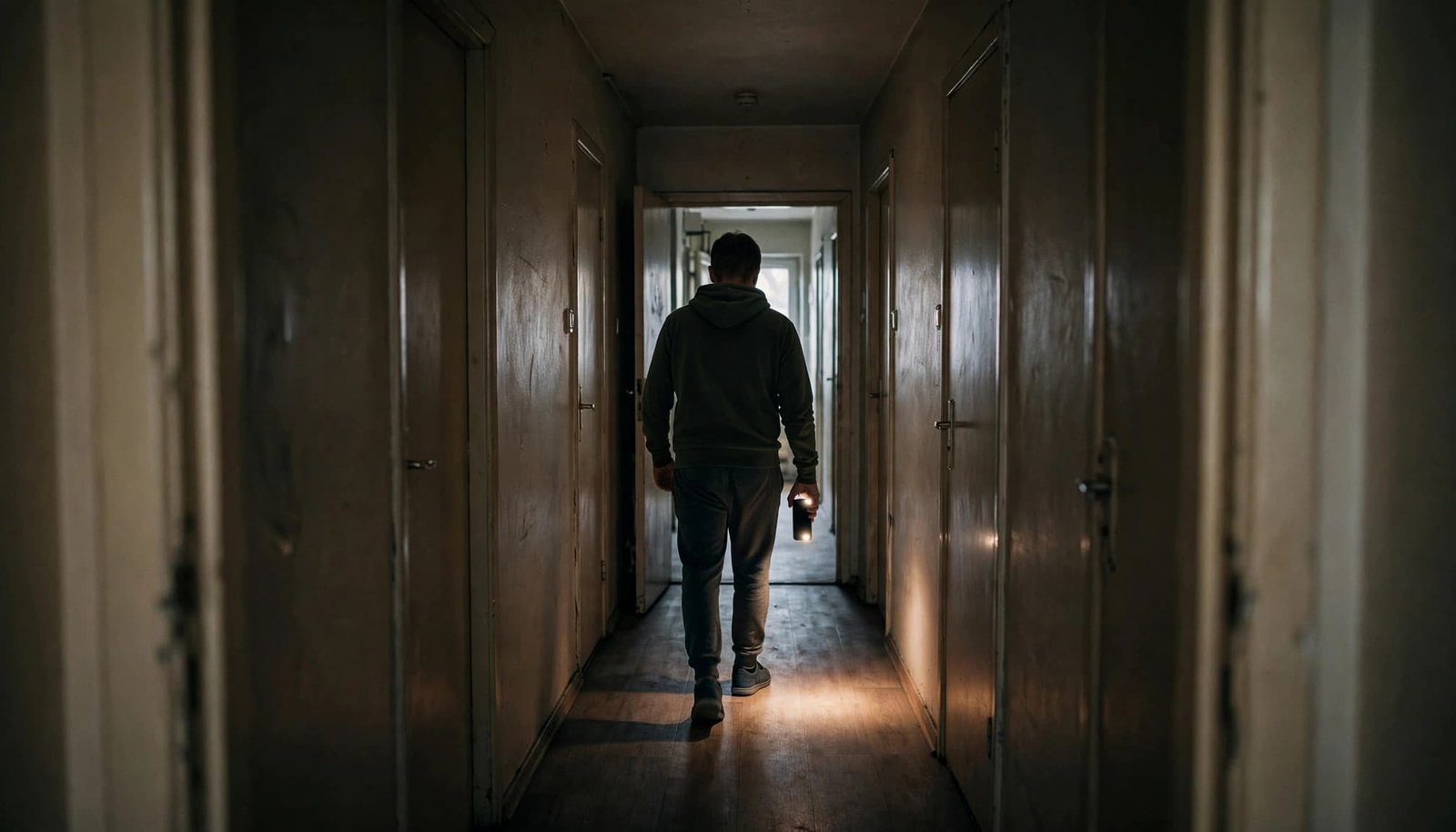
Stop somewhere stable and turn on a flashlight. If your phone is your only light, use it briefly while you reach a dedicated battery light.
Aim the beam toward the walking surface so you can see steps, packages, and loose rugs. On stairs, use the handrail and keep one hand available.
Ready.gov’s outage preparation guidance recommends flashlights, lanterns, and other battery-powered lights. Candles add an avoidable fire risk to an already awkward situation.
Stop when you notice danger
Smoke, sparks, exposed wires, burning-plastic odors, or water near electrical equipment mean you should stop investigating. Leave the affected area without approaching the hazard and call 911 from safety.
Never touch a wet panel, damaged switch, or suspect fixture. A light that flickers back on hasn’t proved the wiring is safe.
During a fire or alarm, follow your building’s emergency procedures. Never use an elevator to escape a fire. If stairs or dark corridors prevent safe movement, tell emergency responders your location and mobility needs.
Is It One Fixture, Your Apartment, or the Building?
Observe the pattern without taking anything apart
From a safe position, notice whether nearby lights and your apartment’s other rooms still have power. Ask a neighbor by phone, or look outside through a safe window.
Emergency hallway lights may remain on during a neighborhood blackout. Likewise, a running building generator doesn’t mean every apartment has electricity.
If only your private hallway is dark, our guide to a power outage in one room covers limited, safe checks. Don’t remove switch plates, fixture covers, or wiring connections.
Contact the right party
Report failed common-area lighting to your landlord, property manager, or emergency maintenance line. Give the floor, corridor location, time of failure, and whether stairwell or emergency lights are also out.
For a neighborhood outage, report your address to the utility. Our apartment blackout safety steps cover the broader response without turning this into an electrical detective marathon.
Only reset an identified tripped breaker in your own unit’s panel if you’re authorized and the panel is dry and undamaged. Move it fully OFF, then ON once. If it trips again, leave it off and contact maintenance. Never operate shared building breakers.
How to Stay Safe Until Lighting Returns
A blackout alone doesn’t automatically require evacuation. However, a dark escape route needs urgent attention, particularly when emergency lights aren’t working.
Report that failure immediately. If there’s no immediate danger, avoid unnecessary trips through dark common areas while management addresses the problem. For residents who rely on elevator access, our elevator outage safety guidance explains access planning and what to do if an elevator stops.
Inside your apartment, place a battery lantern on a stable surface away from the walking path. Keep a flashlight near your door rather than buried beneath yesterday’s mail.
A plug-in lamp or smart bulb provides no blackout lighting unless it has a working battery or another suitable backup supply.
Keep packages, shoe racks, and entryway storage inside your unit and away from exits. A power failure is a poor time to discover that your apartment organization system occupies the escape route.
Never stretch an extension cord across a shared corridor or prop open a fire door to borrow light.
How Far Apart Should Hallway Ceiling Lights Be?
Once the immediate problem is resolved, better everyday lighting can reduce dark gaps in your private hallway. Use ceiling height to plan fixture spacing in private spaces. Shared corridors require building-approved designs and any applicable emergency-lighting provisions.
Use ceiling height as a starting point
For an 8-foot ceiling, a typical planning range is 6 to 8 feet between fixtures. With 9- to 10-foot ceilings, spacing can extend to 8 to 10 feet.
Treat 6 to 8 feet as a starting point, not a guarantee of coverage or a fire-code requirement. Beam spread, fixture output, wall color, and corners affect the result.
Place the first fixture roughly 3 feet from the hallway entrance, rather than tight against the end wall. That position helps spread light near the doorway. Also account for the far end, turns, and any recessed entrances.
Calculate a starting fixture count
Divide hallway length by the proposed spacing. For a 24-foot hallway with an 8-foot ceiling:
24 / 8 = 3 fixtures, while 24 / 6 = 4 fixtures.
That gives you a starting range of three to four fixtures. The final layout still needs balanced end spacing and enough light at each doorway.
For recessed lighting, arrange fixtures in a straight line down the ceiling’s center so neither wall looks darker. Keep other ceiling fixtures centered, too, and avoid oversized fittings that crowd a narrow hallway.
Which Hallway Fixtures Work in a Small Apartment?
Choose ceiling lights based on available clearance before appearance. A chandelier that greets your forehead is an enthusiastic but unhelpful host.
Here are the main options for a private hallway.
| Fixture type | Where it fits | Main advantage |
|---|---|---|
| Flush mount | Standard 8-foot ceilings | Sits directly against the ceiling and minimizes lost headroom |
| Semi-flush mount | Slightly taller ceilings | Hangs a little lower and adds upward glow |
| Recessed lighting | Approved ceiling installations | Gives a clean look without a projecting fixture |
| Linear fixture | Longer corridors | Spreads light along the hallway’s direction |
A low-profile flush mount is generally the safest, most versatile choice under a standard 8-foot ceiling. A semi-flush mount adds upward light and layered illumination when there’s adequate clearance.
Compared with a flush mount, a semi-flush mount can suit a compact entry with enough headroom, while linear fixtures work better along longer corridors.
Two evenly spaced linear fixtures can illuminate a corridor when their length, output, and beam coverage suit the space. Linear fixtures can cover longer runs, but check that light reaches the full walking path. This arrangement isn’t a universal replacement for a proper lighting layout.
Recessed lighting gives a clean, low-profile look without a projecting fixture when the ceiling is approved for installation. In a narrow hallway, recessed lighting can keep the ceiling clear, but the layout still needs to spread light across the walking path.
Lumens measure brightness, while color temperature describes the light’s appearance. Home Depot’s lumen guidance distinguishes warmer, lower-K light from cooler, higher-K light.
For a comfortable private hallway, warm white around 2700K to 3000K is a useful starting point. Cooler tones can look brighter without adding lumens. Choose ceiling lights with diffused or shaded covers to limit harsh contrast. These covers also reduce glare from exposed bulbs. Use one consistent color temperature.
Renter-Friendly Hallway Lighting Without Rewiring
These renter-friendly apartment lighting options belong inside your apartment with appropriate permission. Don’t add fixtures, cords, adhesive strips, or hooks to shared corridors yourself.
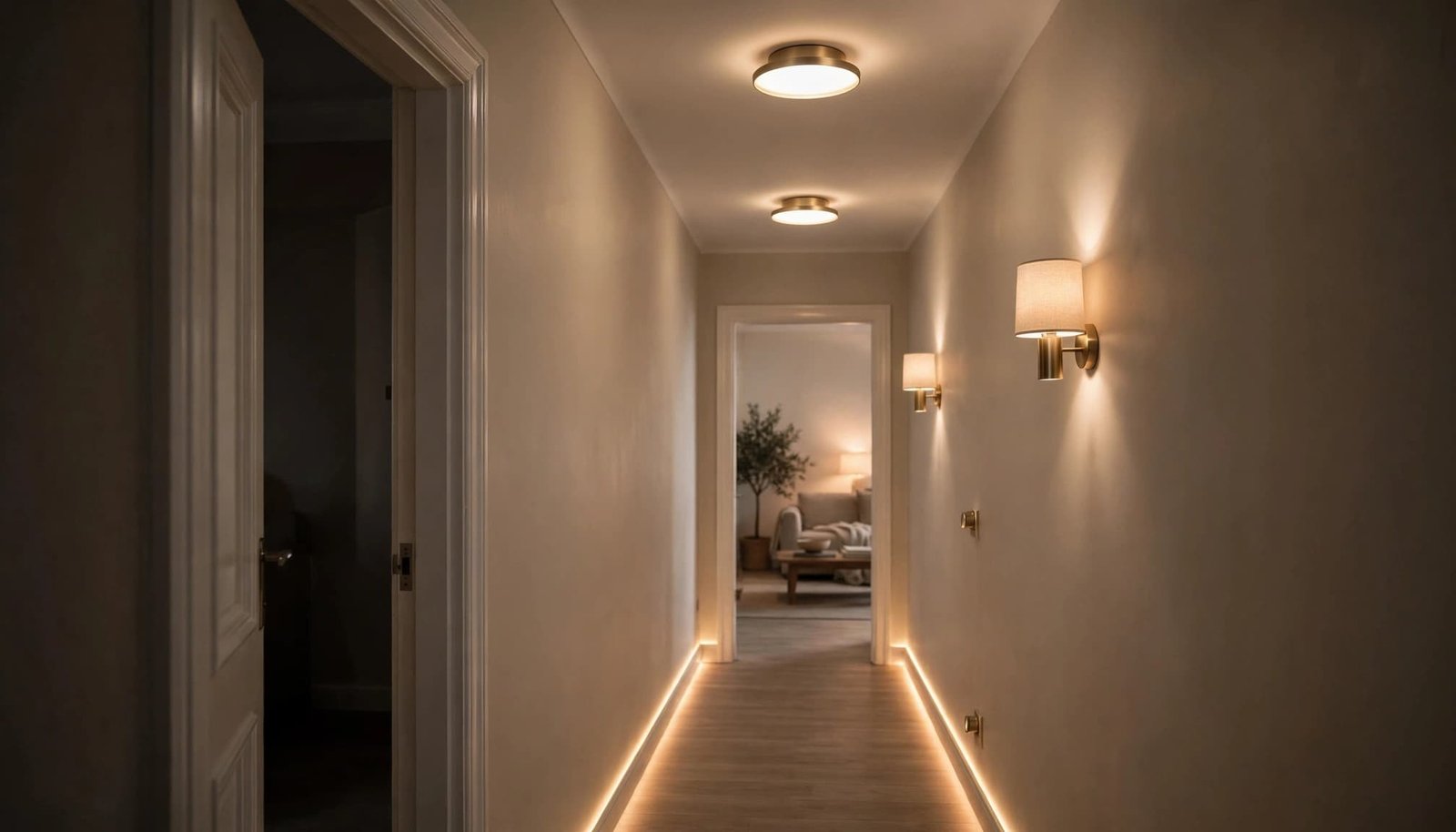
Combine ceiling light with plug-in options
Plug-in wall lights save floor space when hardwiring isn’t possible. For flexible apartment lighting, place them beside beds or seating, then reuse them after a move.
Pair a ceiling fixture’s general lighting with plug-in wall lights near an entry console. Together, they provide general lighting while keeping floor space open. Keep plug-in wall lights’ cords secured outside walking routes and door openings.
Plug-in pendants hang from ceiling hooks and connect to nearby outlets, which allows flexible placement without new wiring. However, hooks still require permission and suitable support. In a low corridor, choose a wall light or flush mount to reduce glare.
Ready.gov’s home-fire precautions warn against worn or broken lighting cords. Retire damaged equipment rather than disguising it behind furniture.
Add layers without creating clutter
General lighting illuminates the whole space. Task lighting helps with activities such as finding keys, while accent lighting highlights a feature. Mood lighting creates a softer atmosphere.
Use general lighting to keep the path visible, then add accent lighting to highlight artwork or a mirror.
IKEA’s broad rule of thumb is about five to seven light sources per room. A narrow hallway doesn’t automatically need that many.
LED strips in coves or along floor edges can add light and make the corridor appear wider. Use them as accent lighting, and keep them secured. Decorative LED strips aren’t blackout backup or emergency lighting.
Use mood lighting near seating or artwork, and keep it separate from the lighting needed for safe movement. Smart lighting lets you adjust hallway ambiance from your phone. It can control mood lighting, but may depend on power, Wi-Fi, or a hub. Keep a separate battery light for outages.
Keep a Compact Hallway Outage Kit
You don’t need to surrender a closet to preparedness. Small-space organization works best when the important gear is easy to reach.
Keep a flashlight, spare batteries, a small LED lantern, and a charged phone power bank together near your exit. Add a paper contact list with management’s emergency number and your utility’s outage-reporting number.
Choose a reachable shelf or small bin inside your apartment. Avoid blocking a door, and don’t store emergency supplies in shared stairwells.
Our renter-friendly blackout preparation guide covers a broader kit without requiring a generator. Ready.gov’s power outage advice also addresses generator hazards. Never run a fuel-burning generator inside an apartment, hallway, or on a balcony.
After an outage, recharge batteries and replace depleted supplies. A flashlight with flat batteries is merely an unusually serious-looking paperweight.
Frequently Asked Questions
Should you replace a burned-out shared hallway bulb yourself?
Report it to management instead. Even a simple-looking fixture can involve unsafe access, damaged components, or building-controlled equipment. Don’t climb furniture or bring a ladder into the shared corridor.
Can a motion-sensor light help during a blackout?
Yes, if it runs on batteries and has sufficient charge. A plug-in motion light without battery backup stops when its supply fails. Inside your unit, place battery lights where they reveal steps and obstacles.
What if management doesn’t respond to failed emergency lighting?
Continue reporting through the emergency maintenance channel and save written messages. For an unresolved safety concern without immediate danger, contact your local fire prevention office or housing-code department. Call 911 for immediate danger.
Make the Next Dark Hallway Easier to Handle
When hallway lights fail, focus on visibility and safe access before troubleshooting. Report shared-system failures promptly and leave electrical repairs to qualified personnel.
For your private hallway, balanced fixture spacing and low-profile lighting improve everyday visibility. A reachable battery light handles the moment those fixtures go dark, without candles, trailing cords, or a midnight search through the junk drawer.